The goal
See how a small development board could recognize a handwritten number using two different computing methods.
Completed coursework · EE 171 · May 2026
ARM + FPGA neural-network inference on the PYNQ-Z2. A hands-on study of software execution, a FINN hardware accelerator, and what makes a performance comparison meaningful.
The project in plain language
See how a small development board could recognize a handwritten number using two different computing methods.
I ran one version on the board’s general-purpose processor and another using a prebuilt accelerator on its reconfigurable chip. I checked their answers and timed 100 repetitions.
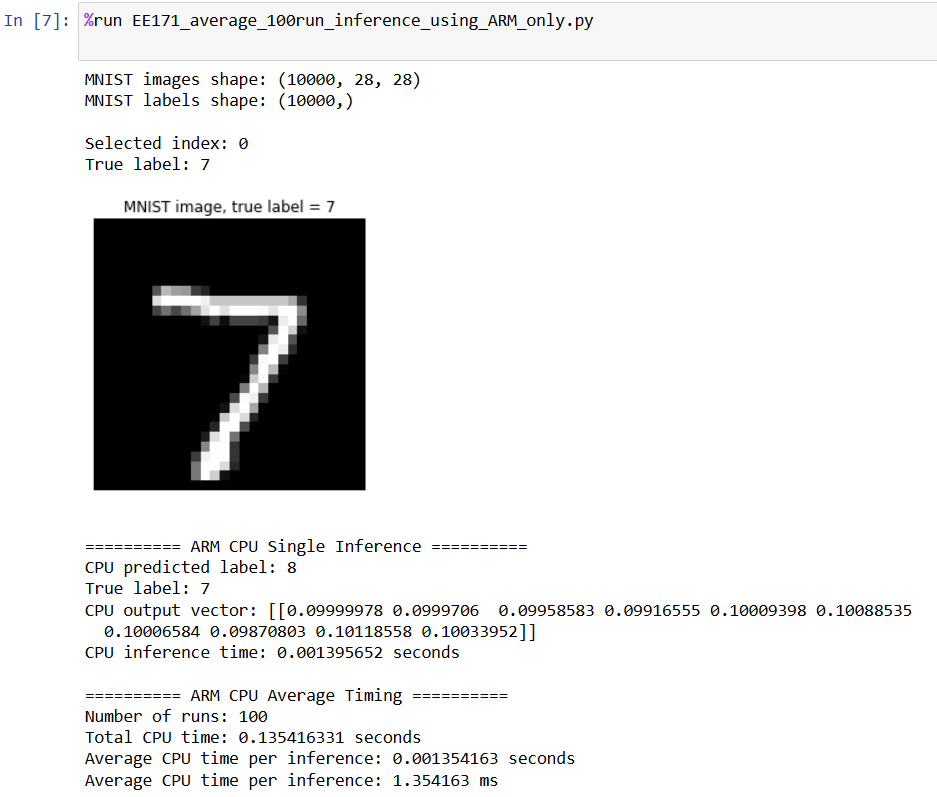
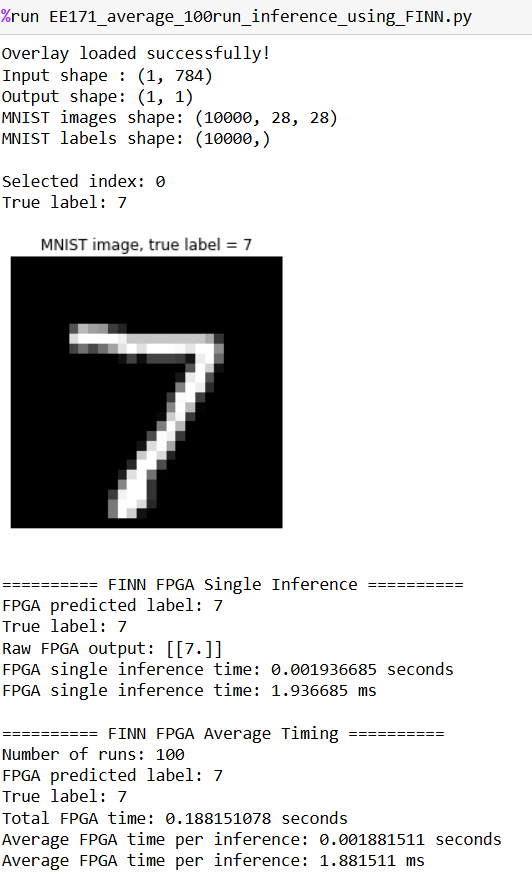
For the pictured 7, the processor version answered 8 and the accelerator answered 7. The models had different training conditions, so these results do not prove that one kind of chip is better or faster.
01 / The experiment
I executed two inference workflows on the same development board: a software path on its ARM processor and a FINN overlay on its FPGA programmable logic. I recorded single-inference timing and averages over 100 runs, then compared the predictions with the sample’s known label.
MNIST image → software neural-network execution → predicted digit and timing.
MNIST image → loaded FINN overlay → predicted digit and timing.
The screenshots show a dataset of 10,000 images at 28 × 28 pixels and sample index 0, whose true label is 7. The report’s isolated 23 × 23 dimension is a transcription error; the displayed execution output shows 28 × 28.
02 / Recorded results
| Execution path | Single run | Mean of 100 runs | Prediction for 7 |
|---|---|---|---|
| ARM CPU | 1.395652 ms | 1.354163 ms | 8 — incorrect |
| FINN FPGA | 1.936685 ms | 1.881511 ms | 7 — correct |
03 / Execution evidence
Original screenshots from the coursework demonstration. Select an image to inspect the full-resolution output.
04 / Engineering reflection
Running ARM and FPGA inference workflows, loading a FINN overlay, checking prediction output, collecting repeat timings, and documenting experimental limitations. These materials establish overlay use and evaluation, rather than authorship of the accelerator architecture or model training.
Use matched trained models and consistent preprocessing; define timing boundaries and warm-up; evaluate a representative test set; and measure latency variation, throughput, resource usage, and power before drawing broader conclusions.
Cryptography was considered but not implemented in this coursework. No hardware limit for cryptographic computation was measured. Homomorphic encryption is a separate future research effort.